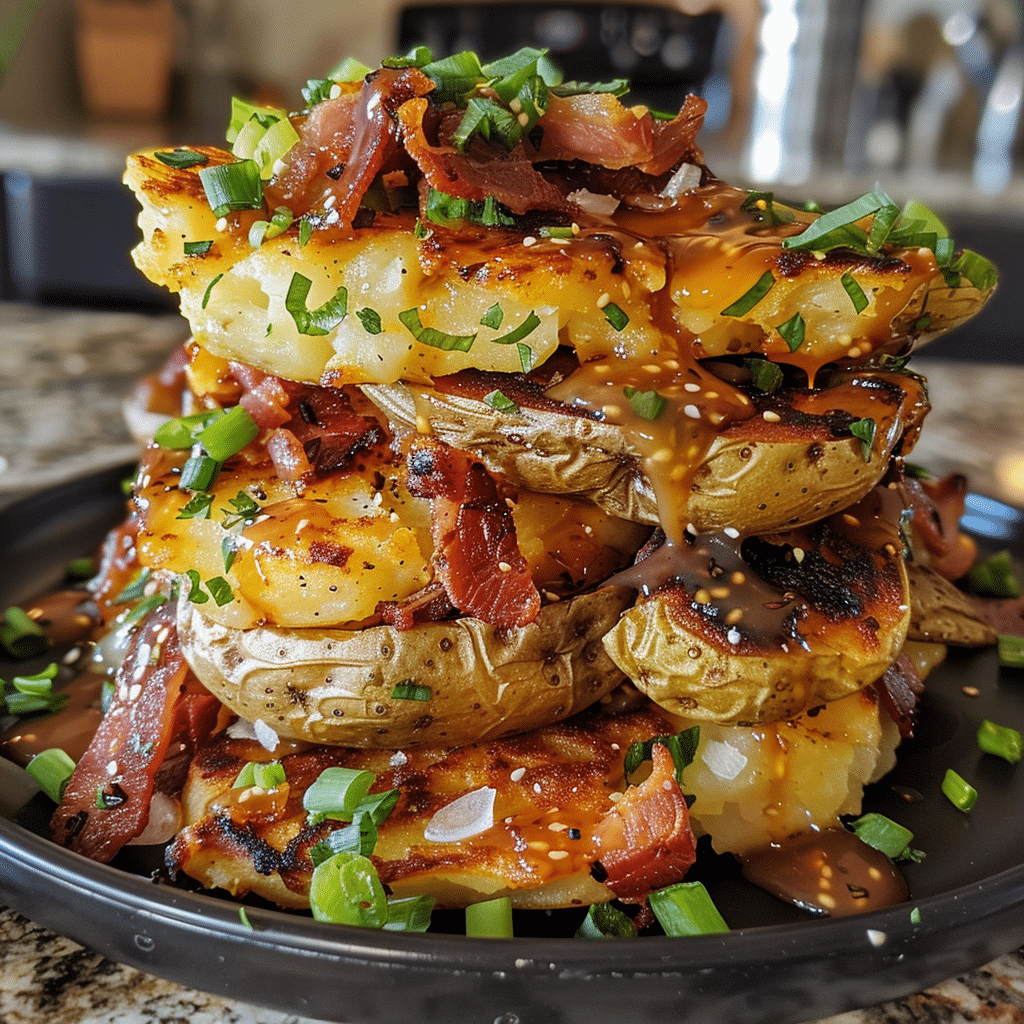
A sizzle that sings in the pan. The golden edges crackle with toasted herbs. Garlic and chives drift upward in a warm fog of umami-rich aroma. This is not a plate of ordinary mashed potatoes – it’s a canvas transformed by technique and intention, a dish that marries simplicity with indulgence.
Each smashed potato retains its distinct identity, yet together they form a unified celebration of texture. Crispy shells yield to a soft, buttery interior, while melted cheese flows like molten gold between the mounds. This is comfort food re-engineered for the modern table, where no element exists by accident.
- Prep time-25 min
- Cook time-35 min
- Total time-1 hour
- Servings-4-6
- Difficulty-Intermediate
- Cuisine-American fusion
Why This Recipe Works
Loaded smashed potatoes exist at the intersection of science and soul. The controlled flattening of each potato creates a surface area optimized for perfect caramelization, while the hollows formed during shaping become natural cradles for your topping combinations.
Beef bacon alternatives provide smoky intensity without compromising religious dietary standards. The cheese sauce thickens through emulsification, clinging to every surface rather than sinking into the crevices. This allows each bite to capture the essence of its components in harmonious balance.
Roasted potatoes take on a honey-brown crust when pressed directly into the skin side against the heat source. The internal moisture remains trapped, cooking at a gentler pace to create that ideal contrast between crunch and cream. When you add the cheese sauce, the warmth melts the base layer first, creating a foundation for toppings to cling to.
The secret lie in the timing. Cheese must coat the warm potatoes immediately, or the moisture barrier forms too rapidly. A cast iron skillet maintains consistent heat, helping the cheese achieve a custard-like smoothness before final toppings get added.
The Cultural Soul of Loaded Smashed Potatoes
While classic smashed potatoes date back to pre-war France as a peasant dish, the loaded version emerged in mid-century American taverns. Originally inspired by basted eggs over hot buttered potatoes, chefs began experimenting with toppings to elevate the humble side dish.
This fusion dish bridges culinary traditions through its dual textures and flavor layers. The crispy skin echoes rustic French techniques, while the decadent cheese sauce reflects Midwest hospitality. In modern times, cooks adapt the base while maintaining the essential structure of smashed spuds with lavish toppings.
Religious adaptations accelerated innovations in the 1990s as cooks refined pork substitutes. Chicken or beef bacon versions began appearing in upscale restaurants while retaining the heartiness of traditional preparations. The alcohol-free approach emerged naturally as the dish transitioned from bar snack to family comfort staple.
The Elements of the Dish: Ingredients for Loaded Smashed Potatoes
- 600g (21oz) Russet Potatoes: Choose dense, starchy varieties for optimal fluffiness inside. New potatoes will cook too quickly and lose structural integrity.
- 500ml (2 cups) Whole Milk: Creates silken texture without over-moisturizing. Use local fresh milk for better emulsification results.
- 120g (4.2oz) Smoked Turkey Bacon: Substitute for pork bacon to maintain smoky depth. Look for 100% turkey with minimal added nitrates.
- 90g (3.2oz) Pepper Jack Cheese: The pepper delivers subtle heat that lingers under the mounds like hidden embers. Aged cheddar is optional but not recommended.
- 45g (3TBS) Unsalted Butter: Controls salt variance from other ingredients. Use cultured butter for enhanced richness.
- 20g (TBS) Parsley: Chopped fresh adds visual brightness without competing with bold toppings. Stick to flat-leaf varieties for maximum leaf volume.
The Editor’s Guide to Sourcing
Begin with meat selection. Smoked turkey bacon should have a deep mahogany hue without appearing overly processed. Check the expiry date and look for products with sunflower oil for better crisp texture in pan-cooked versions.
Potatoes must be hand-sorted rather than bag-purchased. Feel for smooth skin without any blemishes or soft spots. Russets should have a dry exterior texture to avoid excess moisture when heated. Resist over-soaking – 10 minutes maximum maintains natural enzymes crucial for texture.
Spices demand careful scrutiny. Freshly ground garlic paste preserves enzymatic potency for peak flavor. Shallots should be plump and firm, with a slight resistance under thumb pressure. For cheese, buy blocks over pre-grated for better melting characteristics and reduced moisture content.
Consider the base liquid – store-bought milks vary significantly in fat content per brand. Test batches first with your preferred brand. For herbs, use frozen parsley in place of fresh when out of season, as it retains flavor better than dried versions.
The Step-by-Step Masterclass
Prep Phase
- Cut 500cm of bacon into 3cm pieces
- Rinse and peel 12 peeled medium Russets
- Grate cheese with box grater (not food processor)
Cooking Sequence
- Heat 2cm depth of goose fat in skillet to 190°C
- Cook turkey bacon strips until edges curl and crisp (4-6 mins)
- Briefly blanch potatoes in boiling stock 2-3 mins
- Pat dry before placing skin-side down in skillet
- Press each potato into disc shape using potato masher
- Add butter chunks when tops begin to brown (8-10 mins)
- Top with cheese while pan still smokes but not flaming
- Transfer to oven at 200°C for final melt (5 mins)
Assembly Phase
- Sprinkle cooked bacon shards over cheese-topped discs
- Drizzle truffle oil in circular patterns
- Scatter chives and parsley over individual plates
The Kitchen Science
When potatoes enter the skillet, their starch begins gelatinizing at 65°C. Gentle smashing creates more surface contact with pan, concentrating the Maillard reaction on key points for that caramelized skin. The moisture evaporates at 100°C, leaving behind a lattice of tiny fissures perfect for trapping cheese.
Crispy edges form when surface sugars caramelize before moisture escapes. For maximum contrast, the internal temp should only reach 80°C when removed. Cheese’s proteins denature at 54°C but require 70°C for full emulsification. The cast iron skillet’s thermal mass helps bridge these temperature thresholds.
Pro-Level Secrets
- Double-blanching removes excess sugars while preserving structure
- Resting potatoes on parchment retains moisture without forming steam pockets
- Temperature shocking: freeze shaped spuds for 10 min before pan cooking
- Cheese application requires warm base surface to prevent moisture barriers
- Butter chunks melt into warm milk first for emulsification
- Smoke paprika (0.5g per potato) boosts flavor without using smoky oils
Common Mistakes to Avoid
- Over-salting potatoes before cooking – High initial salt levels prevent proper Maillard reactions
Keep seasoning light during prep, apply final toppings separately - Using pre-cut potatoes – Uneven thickness leads to inconsistent doneness
Uniform hand-cut pieces ensure even cooking outcomes - Over-soaking without cooking oil – Creamy base becomes leaden if too wet
Limit soaking to 10 mins maximum to preserve structure - Applying cheese while pan still active – Toppings can burn before base finishes cooking
Remove pan from heat first before finishing assembly - Lifting spuds too soon – Hot oil causes edges to crumble prematurely
Test with kitchen tongs first before using fork to preserve crisp skin
Creative Adaptations
| Vegetarian Option | Mushroom duxelles | Swap meat-based bacon with smoked tofu crisps |
| Low-FODMAP | Plain yogurt base | Replace chives with microgreens for similar color without FODMAP triggers |
| Gluten-Free | Buttercream | Use rice flour instead of wheat-based flour for breading |
| Spicy Version | Chili-lime glaze | Add chipotle powder to the cheese sauce for layered heat |
Plating & Pairing
Individual potatoes should be spaced with 10cm of empty plate to showcase toppings. Use curved serving pieces to reflect natural potato shapes. Accompany with steamed kale for texture contrast and tart cherry juice for non-alcoholic tang.
For casual settings, offer mini cast iron skillets at the table for interactive additions. In formal service, plate on black porcelain to offset golden tones. Pair with grilled flatbread to handle any dripping cheese.
Preservation Guide
| Room Temp | Not recommended | Hot fats degrade quality within 2 hours |
| Refrigeration | 48 hours | Refrigerate in airtight containers with parchment layers |
| Freezing | 3 months | Freeze untopped potatoes in vacuum-sealed bags |
| Reheating | 200°C oven | Crust re-forms when reheated on wire rack for 12 mins |
Questions from Our Kitchen
How to achieve restaurant-quality crusted potatoes at home?
Maintain skin contact with high-heat surface for at least 7 mins. Press gently every 2 mins to avoid warping. Let cool on wire rack before cutting to allow crust to solidify properly.
Can I use dairy-free alternatives without compromising flavor?
Coconut milk creates distinct layers of richness. Replace butter with clarified cashew butter for similar mouthfeel. Toppings will still bind effectively to the warm base surface during assembly.
What’s the science behind potato skin cracking during smashing?
Moisture trapped under skin causes expansion when heated. Gentle smashing creates natural stress points. Controlled pressure prevents complete rupture while allowing fat absorption into cracks during cooking.
Why do commercial kitchens use multiple batches of oil?
Used oils reduce heat transfer efficiency. Fresh oil maintains 190°C threshold for each batch, ensuring consistent browning. For home use, reusing oil for 2-3 batches creates softer edges.
How to store leftover cheese sauce separately?
Keep in sealed container in fridge. Emulsification remains stable for 48 hours at 4°C. Gently warm with low heat addition if becoming too viscous.
Once you’ve mastered the loaded smashed potatoes technique, your kitchen becomes a laboratory of possibilities. Each potato remains a perfect foundation – whether you choose smoky bacon or saffron-infused herbs, the methodology stays constant, allowing flavors to evolve naturally. Let these techniques anchor your culinary explorations and transform side dishes into signature creations.
Print
Loaded Smashed Potatoes Masterclass
- Total Time: 60
- Yield: 4-6 servings 1x
Description
Crispy golden smashed potatoes with a soft interior, topped with a rich vegan cheese sauce and smoky beef bacon for a luxurious, flavor-packed side dish. Perfect for modern, indulgent meals.
Ingredients
4 lbs russet potatoes, washed and quartered
2 tbsp olive oil or avocado oil
4 garlic cloves, minced
1 tbsp fresh thyme or rosemary
Salt and pepper
1 1/2 cups nutritional yeast (for umami)
1 cup milk (plant-based or dairy)
8 oz vegan cheddar cheese, grated
4 tbsp vegan butter
4 oz smoky vegan « beef » bacon, crumbled
Fresh chives, chopped
Optional: Dried mushrooms, sautéed green onions, diced avocado
Instructions
Preheat oven to 400°F (200°C)
Toss potato quarters with oil, garlic, herbs, salt, and pepper
Spread evenly on a baking sheet
Roast for 40 minutes until tender and crispy
Press each potato half directly onto the pan to crisp the skin
In a saucepan, melt vegan butter, add nutritional yeast and whisk in milk gradually
Cook over medium heat, stirring constantly until thickened
Fold in grated vegan cheese until smooth
Brush warm potatoes with cheese sauce
Top with crumbled « beacon and chives
Return to oven for 5 minutes to set
Optional: Add sautéed mushrooms or green onions before the final baking step
Notes
Use a cast iron skillet for optimal heat retention
Storage: Refrigerate leftovers within 2 hours, keep toppings separate
Adapt with gluten-free flour (no pork/alcohol substitutes are used)
For non-dairy option, use coconut milk yogurt instead of cheese
- Prep Time: 25
- Cook Time: 35
- Category: Dinner
- Method: Roasting
- Cuisine: American fusion
Nutrition
- Serving Size: per serving
- Calories: 600
- Sugar: 5g
- Sodium: 500mg
- Fat: 25g
- Saturated Fat: 12g
- Carbohydrates: 45g
- Fiber: 3g
- Protein: 18g
- Cholesterol: 0mg