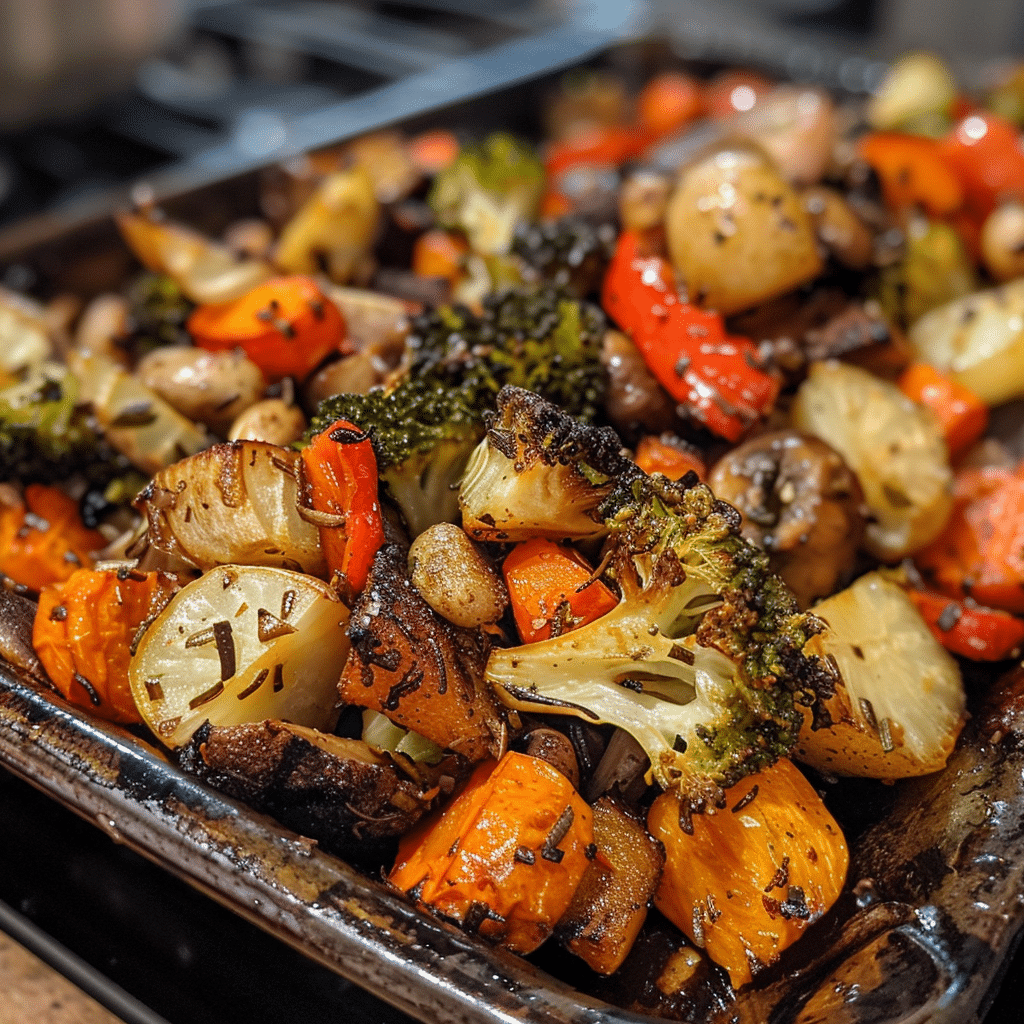
The sizzle of garlic meeting hot olive oil, the deep smokiness of roasted skin vegetables, and the sweetness bubbling from tender flesh—this is more than cooking. It is transformation. Each clove becomes a conductor of flavor, orchestrating a dish where edges crisp into golden brown perfection while centers soften with honeyed depth.
Garlic roasted vegetables work their alchemy on simple, fresh produce. The key lies in balancing heat, fat, and time to coax out the natural sugars hiding in the root-to-stalk ecosystem of the vegetable world. This technique turns humble ingredients into a side dish that commands attention and complements nearly any protein—beef, chicken, or even plant-based alternatives.
Let me guide you through the steps, secrets, and science behind this culinary classic. Whether you’re a home cook or a seasoned chef, you’ll discover how to roast vegetables until their surfaces gleam with garlic-infused char and their interiors melt without losing structure.
- Prep Time– 15 minutes
- Cook Time– 35-40 minutes
- Total Time– 50-55 minutes
- Servings– 4-6
- Difficulty– Easy
- Cuisine– Mediterranean-inspired
Why This Garlic Roasted Vegetables Recipe Works
Oven-roasted vegetables with garlic aren’t just a side plate filler. They’re a flavor revolution. At 425°F, raw vegetables shed their earthy neutrality, becoming instruments of caramelization. The golden-brown edges? A textural triumph that bites back against the tender cores.
Garlic doesn’t just linger on the surface here. It emulsifies into the fats released by roasting, seeping into every crevice. Unlike boiled or steamed vegetables, which retain their muted tones, this method gives you the deep mahogany color of transformed chlorophyll. The result? A dish where bitterness dissolves into sweet umami, and moisture becomes its own glaze.
Using olive oil creates a fat-soluble flavor highway. Those oils carry garlic’s pungent compounds deeper into vegetable cells, binding to cell walls and creating a long-lasting impression on the palate. Even after hours of cooling or reheating, the garlic remains clingy, persistent, and deeply savory.
Seasoning early ensures each vegetable cell absorbs the magic. But the final salt addition—right before serving—reinforces brightness without overwhelming the roasted essence. It’s the difference between salted afterthought and salted revelation.
And the vegetables! Broccoli, cauliflower, and Brussels sprouts contribute varying textures—some crisp, some fibrous—to create a mosaic of contrasts on the plate. Carrots add a natural sweetness, while shallots throw in a subtle piquant kick that balances the equation.
The Cultural Soul of Garlic Roasted Vegetables
This dish roots itself in the Mediterranean tradition of roast vegetable medleys. Greeks perfected rosticci in olive groves, while Italian families developed contorni using local fields. The French, ever the culinary theorists, elevated charred vegetables to charcuterie-level importance with their gratins and salades tièdes.
Roasting vegetables became a solution for seasons of abundance. Before industrial canning, preserving excess harvest meant drying, frying, or roasting. Garlic provided both antimicrobial benefits and a flavor anchor, ensuring that each batch tasted memorable. This was cooking with intention—honoring the cycle of food and fueling communities for millennia.
Modern variations blend cuisines. Korean chefs introduce gochugaru pepper flakes for a charred-sweet-heat trifecta. Middle Eastern dishes add za’atar before roasting, layering lemon-thyme complexity. The core remains the same: vegetables as the hero, garlic as the narrator of their story, and roast as the method that writes the ending.
The fusion here isn’t forced. It’s natural evolution. A cast-iron Dutch oven from France works as well as a Japanese donabe clay pot. Both focus heat and oil where it matters most: directly onto skin surfaces.
The Elements of the Dish: Ingredients for Garlic Roasted Vegetables
- 4 large Brussels sprouts Ingredient: Choose leaves crisp yet slightly yielding when squeezed. Remove any loose outer leaves for even roasting.
- 2 heads cauliflower Ingredient: Opt for tight curds with a pale hue. Cut into small florets to maximize surface-to-fat contact.
- 1 large broccoli crown Ingredient: Look for dark green stalks and vibrant tips. Trim the base to help steam while roasting.
- 10 baby carrots Ingredient: Organic purple-top varieties resist moisture loss better than standard orange.
- 1 large red onion Ingredient: Thin wedges caramelize faster than thick slabs. The skin adds earthiness to the final dish.
- 5 cloves garlic Ingredient: Fresh, peeled cloves outperform roasted. Their oils need direct flame to ignite complexity.
- 3 tbsp olive oil Ingredient: Use extra-virgin for its fruity backbone. Avoid refined oils that lack heat resilience.
- 1 tbsp apple cider vinegar Ingredient– A splash cuts through fattiness, ensuring moisture doesn’t pool in the pan.
- Salt to taste Ingredient– Use coarse sea salt for texture. Add final touches when the tray exits the oven.
- Pinch black pepper Ingredient– Freshly ground pepper enhances garlic’s boldness without stealing visual attention.
The Editor’s Guide to Sourcing
Select Brussels sprouts in tight clusters with no yellowing. Cauliflower must feel heavy for its size—this indicates hidden moisture. For broccoli, seek out stems that are tender even without steaming; these react better to high heat.
Olive oil must be unfiltered and cold-pressed. Refined oils lack the chemical compounds that carry aromatics deep into vegetables. Look for a robust peppery finish in your oil—it will hold up to the blistering heat of roasting.
Garlic’s importance cannot be overstated. Choose bulbs with taut papery skin. Avoid pre-peeled jars; they oxidize too quickly. Crushing the cloves just before cooking releases allicin, the compound responsible for that signature garlic bite.
Carrots should be harvested in cool weather. Their starch-to-sugar conversion becomes sweeter in frosty conditions. Red onions vary by region—Spanish varieties are milder, while Italian ones burn faster. Choose based on your intended finish: crispy with minimal tang or charred with bold heat.
For the vinegar, avoid white distilled. Apple cider or balsamic offers flavor depth that integrates with the pan’s drippings. A high-quality vinegar will cling to the oil rather than burn away during high-heat roasting.
The Step-by-Step Masterclass
Vegetable Preparation
Trim stems and cut larger vegetables into 1-2 inch pieces. Too small and they’ll char before cooking through. Too large and they’ll steam more than roast. The goal is skin contact with heat—every piece must be a potential canvas for caramelization.
Tossing the Elements
In a large bowl, combine vegetables with olive oil. Add half the garlic—whole cloves ensure even flavor distribution. Stir until each cut surface glistens. A proper oil coating makes the difference between soggy and shatteringly crisp outer edges.
Oven Choreography
Preheat to 425°F for 20 minutes. Transfer mixture to a rimmed baking sheet using parchment as a clean-up tool. Don’t crowd. Each piece needs space to brown—overlapping means moisture accumulation, not caramelization.
Roast for 12 minutes, then flip pieces until the garlic reaches a mahogany hue. Add vinegar three minutes before finishing to trigger Maillard reactions without drying. The acid sharpens the roast while helping oils cling to vegetable surfaces.
The Kitchen Science
High heat (425°F and above) initiates Maillard browning faster than lower temperatures. At this stage, amino acids on the surface react with reducing sugars to form 500+ flavor compounds. Garlic, rich in amino acids, jumps into the chemical dance early, embedding itself into vegetable cells.
The vinegar adds a secondary role. Its acetic acid lowers the pH slightly, which accelerates caramelization in vegetables by breaking down cell walls. This is why the dish reaches peak sweetness just shy of burning—the acid protects the sugars until they’re at their richest.
Cast iron holds heat like a thermal reservoir. If using a metal sheet, expect faster charring. Silicon or glass trays trap moisture, forcing you to flip more often. For this dish, metal is ideal, but only if spaced properly to ensure air movement between pieces.
Pro-Level Secrets
- Use a cast iron sheet—it retains 425°F better than glass, ensuring even browning.
- Preheat the baking sheet: place it in the oven while you prepare ingredients. Hot surface = fast char.
- Flip mid-roast: First round at 12 minutes. Final turn 3 minutes before finish for double-browndeepness.
- Don’t season too early: Salt draws out moisture before the Maillard reaction can begin. Add it fresh from the oven.
- Use vinegar for sheen: A splash in the last minutes creates glossy edges and cuts through fat.
- Add lemon zest at the end: Fresh citrus brightens the finish and prevents oil from becoming greasy.
Common Mistakes to Avoid
- Problem – Overcrowding the tray Why – Condensation prevents browning Solution – Use separate trays or rotate them during cooking.
- Problem – Peeling garlic too early Why – Oxidation loses potency Solution – Crush garlic directly on the tray mid-roast.
- Problem – Overcooking leafy parts Why – They burn before others cook Solution – Tuck Brussels or broccoli in the center for protection.
- Problem – Using low-oil ratios Why – Inadequate moisture for Maillard reactions Solution – Maintain 3 tbsp oil minimum for 4 cups of vegetables.
- Problem – Skipping vinegar Why – Oil becomes unbalanced Solution – Treat it as a heat moderator, not an optional garnish.
Creative Adaptations
| Core Ingredient | Substitution | Flavor Impact |
|---|---|---|
| Brussels sprouts | Green cabbage | More subtle sweetness, better structure for browning |
| Apple cider vinegar | Pear balsamic | Enhances garlic’s umami while adding sweet-tart contrast |
| Olive oil | Avocado oil | Higher smoke point allows 450°F for faster charring |
| Broccoli | Kale leaves | Thicker cut leaves need less vinegar to balance richness |
| Shallots | Cherry tomatoes | Introduces acidity and moisture, works well with chicken. |
Plating & Pairing
Plate garlic roasted vegetables in overlapping piles to show texture. Use a rimmed plate to catch olive oil drips. Add lemon zest and coarse salt at serving time for aroma and flavor.
Pair with: grilled chicken breast marinated in citrus, a chilled iced basil lemonade, or fermented kimchi. The dish’s savory backbone handles boldness—don’t shy away from adding toasted sesame oil or crushed Sichuan peppercorns.
Preservation Guide
| Refrigerator | 3-4 days in airtight containers |
| Freezing | 2-3 months—blanch before freezing to lock in moisture |
| Reheating | 350°F for 10-15 minutes. Avoid microwave—use fresh olive oil for final shine. |
Questions from Our Kitchen
How do I know when my vegetables are done?
Look for three signs: skin edges curled with visible black spots, internal tenderization when pierced with tongs, and oil pooling that bubbles back on touch. They should hold shape while showing char.
Can I roast mixed vegetables at different sizes?
Absolutely. Root vegetables like carrots need thicker cuts—about 1.5 inches. Leafy options like broccoli florets can stay smaller. Just rotate their positions during mid-roast to ensure even heat contact.
What if my oven has hotspots?
Roast in two batches. Move trays between upper and lower oven racks after 12 minutes. This ensures even browning, especially when using convection settings where heat circulates aggressively.
Is this dish suitable for meal prep?
Perfect. Store in portioned glass containers with minimal oil, then reheat with a cast iron pan to restore crispiness. Adding fresh lemon zest post-reheat brings back that restaurant-level brilliance.
Why add vinegar at the end?
Vinegar interrupts the Maillard process at the last moment. This balances sweetness without ruining char. Too early, and it evaporates before doing its work. The precise timing makes this dish a study in chemistry and control.
Cooking is storytelling
This recipe isn’t just about garlic roasted vegetables. It’s about mastering the art of transformation—seeing how raw textures melt into culinary poetry. Grab your tray, crank the oven, and let each vegetable tell its story through caramelized edges and fragrant centers. Your kitchen awaits.
Print
Garlic Roasted Vegetables
- Total Time: 50
- Yield: 4-6 servings 1x
- Diet: Vegetarian
Description
A Mediterranean-inspired side dish where garlic, olive oil, and high heat transform vegetables into caramelized golden jewels. Rich in texture and sweet umami, this dish complements proteins or shines alone.
Ingredients
2 tablespoons olive oil
6 cloves garlic, minced
1 head broccoli, cut into florets
1 medium cauliflower, cut into florets
12 Brussels sprouts, halved
2 medium carrots, peeled and sliced diagonally
1 shallot, thinly sliced
1 teaspoon coarse sea salt
½ teaspoon black pepper
½ teaspoon fresh thyme or parsley (optional)
Instructions
Preheat oven to 425°F (220°C). Line a baking sheet with parchment paper.
Toss broccoli, cauliflower, Brussels sprouts, carrots, and shallot with olive oil and minced garlic until evenly coated.
Spread vegetables in a single layer, ensuring space between each piece.
Season with sea salt and pepper.
Roast for 30-35 minutes, flipping halfway, until edges are caramelized and tender.
Sprinkle thyme or parsley (optional) before serving.
Notes
Use fresh garlic for optimal flavor penetration.
Adjust roasting time based on vegetable size—smaller pieces cook faster.
For extra brightness, finish with a squeeze of lemon juice or balsamic glaze.
Store leftovers in an airtight container for up to 3 days.
- Prep Time: 15
- Cook Time: 35
- Category: Dinner
- Method: Roasting
- Cuisine: Mediterranean
Nutrition
- Serving Size: 1 cup
- Calories: 130
- Sugar: 2g
- Sodium: 350mg
- Fat: 8g
- Saturated Fat: 1g
- Carbohydrates: 12g
- Fiber: 4g
- Protein: 3g
- Cholesterol: 0mg