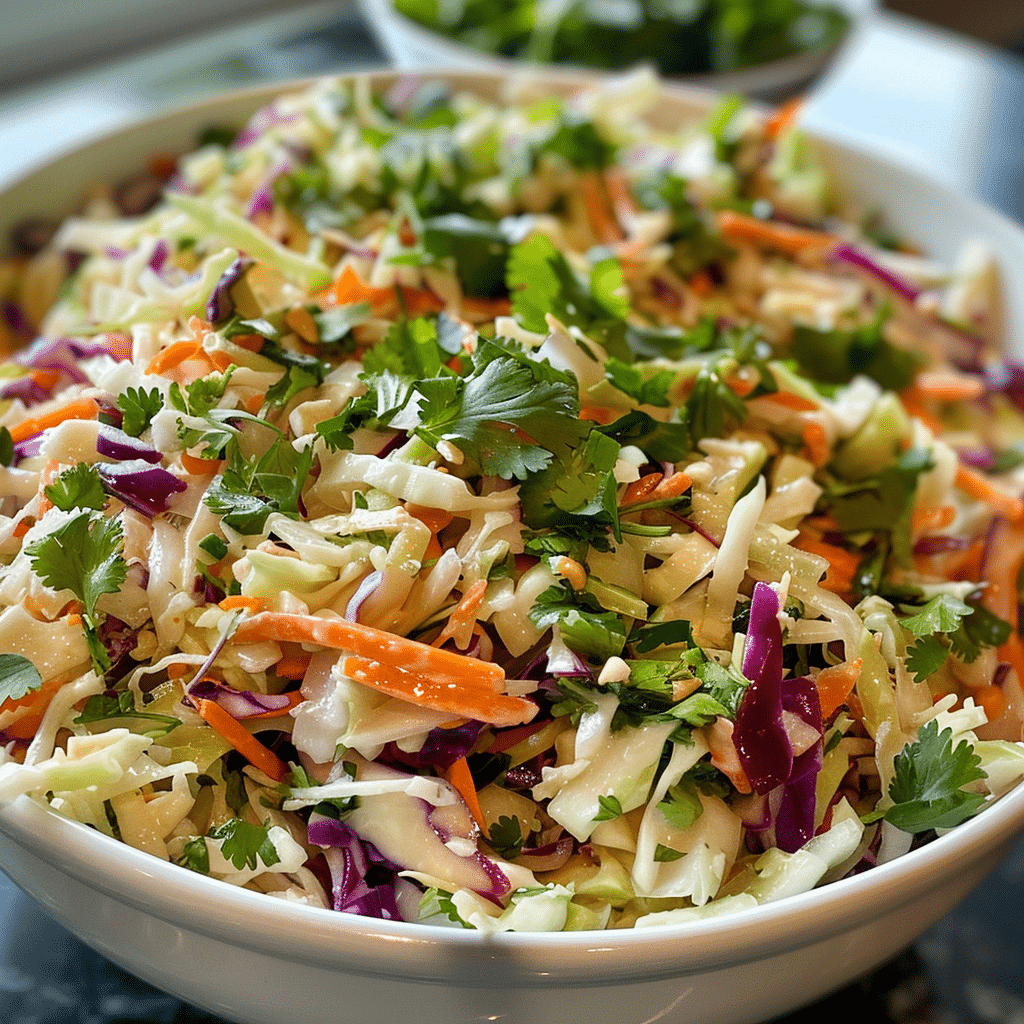
The tangy crunch hits your tongue like a summer zephyr through a market stall in Guadalajara. Refined slices of Napa cabbage glisten under a pool of lime juice that sharpens without drowning, while chopped cilantro delivers a peppery burst you can almost see in the sunlight. A whisper of garlic and a kiss of smoked paprika anchor this vibrant topping, transforming it from side to star.
Imagine the hiss of lime juice meeting sugar snaps, the metallic tang of vinegar cutting through creamy avocado. This is coleslaw done without mayonnaise, where the dance of acidity and herb intensity makes every forkful a revelation. The crunch isn’t just a texture—it’s a declaration of freshness.
Here lies a recipe that redefines tradition: crisp, bold, and built to pair with grilled chicken, beef, or fresh masa. Let’s unravel the alchemy of this no-mayo masterpiece.
- Prep Time– 20-25 minutes
- Cook Time– 5 minutes (dressing prep)
- Total Time– 25 minutes
- Servings– 6 to 8
- Difficulty– Easy
- Cuisine– Mexican
Why This Recipe Works
Conventional coleslaw relies on mayonnaise for its creaminess—but this version swaps it with a lime-cilantro emulsion that’s equally transformative. Lime juice sharpens the cabbage, while cilantro adds a citrusy-herbal layer the mayo world can’t touch.
The key lies in acid balance. Traditional dressings mute the cabbage’s bite, but here, vinegar and lime work in tandem. Red onion shreds brown to translucent sweetness before meeting the lemon-paprika combo, creating a multidimensional crunch without drying the greens.
Avocado enters as a wild card. Its fat content clings to the cabbage like a bridge between acidity and heartiness. Unlike mayo, it breaks down gradually to release moisture, not gloom.
Texture matters. Cilantro stems left in the mix give the salad a grassy backbone, while the leaves add peppery brightness. This isn’t a garnish—it’s a counterpoint to smoky grilled proteins.
Storage magic occurs when you refrigerate the coleslaw in advance. The cabbage absorbs the flavors like a sponge, and the herbs mellow into something more complex. For best results, chill it for at least 2 hours before serving.
The Cultural Soul of Mexican Coleslaw
Salads in Mexican cuisine are far more than condiments. Nopales, romaine, and cabbage have been used for centuries to balance rich meats. The pre-Columbian use of nopal (cactus pads) as a vegetable base evolved alongside Spanish influences, where pickling techniques met native lime trees.
Modern Mexican coleslaw emerged in street food culture as a solution to heat-activated flavor fatigue. Lime juice became the hero, its acidity cutting through the smoky depths of grilled meats. Cilantro followed suit—not just as a garnish, but as a flavor catalyst that interacts chemically with citrus.
Today’s version skips the pork-centric origins but keeps the legacy. Using beef or chicken honors the dish’s hearty roots while opening creative doors. Every ingredient here tells a story of adaptation and fusion without losing authentic spirit.
The Elements of the Dish: Ingredients for Mexican Coleslaw
- 1 head Napa cabbage: Its semi-bulbous leaves hold dressing without becoming soggy. Look for tight heads with yellow-green leaves and a firm core.
- 2 large ribs of red onion: Thinly sliced, they caramelize into translucent sweetness while still retaining structural integrity.
- 1 cup fresh cilantro: Use stems and leaves. Seek bunches with bright green color and no wilting.
- 3 grapefruits: Key to depth of acid. Choose ones that feel heavy for their size with slightly bumpy skin.
- 1/2 cup grilled chicken breast (or skirt steak): The smoky char contrasts with the salad’s brightness. Opt for boneless, skinless chicken or marinated steak.
- 1/4 cup apple cider vinegar: Adds sharpness that complements lime acidity. Raw, unfiltered vinegar preserves natural enzymes.
- 2 cloves fresh garlic: Minced immediately before use maximizes allicin content for bold flavor.
The Editor’s Guide to Sourcing
For the chicken or beef, seek cuts with visible marbling but lean profiles. Chicken thighs add moisture for street-style tacos, while beef skirt steak offers fibrous depth when thinly sliced. Always buy one portion over a pound to avoid rubbery textures.
Cilantro should be purchased loose over pre-packaged. Fresh leaves release oils that pre-cut versions lose. Look for small, dark-green leaves—bigger ones get bitter. Avoid stems with black spots or drooping tips.
Red onions matter: choose those with dry, papery skins that resist crumbling. Slice them at least an hour before dressing to mellow harshness while preserving crunch.
Lime juice requires ripe fruit that feels dense for its size. Roll each fruit on the counter before zesting to loosen oils. For a richer base, use lime halves to make juice and zest in the same recipe—each contributes uniquely to flavor development.
The Step-by-Step Masterclass
Salad Foundation
Quarter the cabbage lengthwise, then carefully remove the core—preserve the integrity of each leaf. Thinly slice the head using a mandoline for uniform texture. The goal is ribbons no thicker than card stock.
For red onion, use a rocking blade on a santoku knife. Arrange slices in a cold, dark glass bowl to slow oxidation. Toss gently so leaves don’t bruise.
Dressing Assembly
Blend 1/2 cup lime juice with 4 tablespoons vinegar. Add 1/4 cup olive oil in a steady stream as the blender runs—this creates an emulsion rather than an oil-and-vinegar sludge.
Strip cilantro stems and leaves. Pulse the leaves with 2 cloves garlic and a 1/2 teaspoon of smoked paprika. The stems can be finely minced to thicken the dressing without overpowering it. For a rustic texture, use a pestle instead of a blender.
Pour the dressing over cabbage. Use tongs to fold ingredients in a figure-eight motion for even distribution. The cabbage should glisten but not drip—adjust with more vinegar if necessary.
Protein Prep
Season grilled chicken breasts with salt and black pepper. Cook over high heat until the flesh turns opaque and separates easily from the bone with a fork. For tacos, slice against the grain at an angle for maximum tenderness.
If using skirt steak, marinate in lime juice and cumin for 30 minutes. Sear on both sides until the edges turn deep mahogany. Thinly slice diagonally to break muscle fibers into manageable bites.
The Kitchen Science
Lime juice and vinegar work through acid hydrolysis. Acids weaken pectin in cabbage cell walls, making leaves tender without sacrificing crunch. The trick is volume: too little acid and the texture collapses, too much and it wilts completely.
Cilantro contains aldehydes that bind with citrus compounds in lime. This chemical marriage unlocks a more intense herb flavor as the salad rests. Refrigeration for two hours allows this emulsification to fully mature.
Avocado oils have a smoke point of 520°F, but in this recipe they act as fat emulsion. The polyphenols in red onion resist breaking down when exposed to acid, maintaining their visual contrast and bite.
Pro-Level Secrets
- Toast smoked paprika on a dry skillet for 30 seconds before adding. The heat releases pyrazine compounds that amplify smoky character without bitterness.
- Use a lime zester for maximum surface area. The grated zest provides floral notes that pure juice cannot replicate.
- Dry brine cabbage with salt for 10 minutes. Rinse thoroughly to remove excess sodium—it tightens water-repelling membranes.
- Blanch red onion in boiling water before slicing. This softens their natural sulfur compounds into something more caramelly.
- Chill the serving bowl in the freezer while making dressing. Cold vessels stop cabbage from warming, preserving texture longer.
- Dice avocado just before plating to prevent enzymatic browning. Press slices under parchment paper with a kitchen towel to draw off excess moisture.
Common Mistakes to Avoid
- Problem– Using regular cabbage. Why– Regular cabbage becomes soggy in 20 minutes. Solution– Stick to Napa for its moisture resistance.
- Problem– Rushing the dressing. Why– Olive oil separation occurs when not fully emulsified. Solution– Gradually add oil while blending at high speed.
- Problem– Skipping texture checks. Why– Cabbage that’s too thin disintegrates during tossing. Solution– Slice with a julienne attachment for mandoline.
- Problem– Over-seasoning with salt. Why– Salt draws out moisture, destroying crunch. Solution– Add salt during final inspection rather than initial mixing.
- Problem– Using plastic wrap over salad. Why– Traps humidity and softens cabbage in 5 minutes. Solution– Store in a glass container with tight lid but minimal air contact.
Creative Adaptations
| Ingredient to Swap | Substitution Option | Impact on Dish |
|---|---|---|
| Chicken | Slow-roasted venison or sautéed shrimp | Deepens richness or adds seafood tang—adjust seasoning to mask fishiness. |
| Lime | Lemon juice + a few drops of lime zest | Reduces acidity while retaining tropical brightness—use less lemon concentration. |
| Cilantro | Parsley stems and leaves (2 cups) | Preserved herb flavor at half the intensity. Adds earthy undertones. |
| Cabbage | Radicchio stalk segments with red cabbage | Introduces bitterness for contrast. Adjust acid quantity in dressing. |
| Vinegar | Pineapple juice or grapefruit segments | Changes pH balance to 3.5 from 2.3. Adjust lime quantity accordingly. |
Plating & Pairing
Present this coleslaw as a taco topper—its acidity needs space to shine. Layer it over warm tortillas, grilled chicken, or even black bean tacos. A single cabbage leaf folded around shredded chicken becomes a handheld salad experience.
Pair with cold aguas frescas—lime juice and hibiscus tea are classics. For non-alcoholic options, a spicy tomato agua with a splash of pineapple juice adds complexity without overwhelming the coleslaw.
Consider ambient cues: dim lighting to heighten the acidity’s brightness, or bright natural light to emphasize its green textures. In tacos, this should be the final addition before folding to prevent cabbage from bleeding.
Preservation Guide
| Storage Method | Duration | Notes |
|---|---|---|
| Air-tight container | Up to 8 hours | Add a paper towel to absorb excess moisture if storing beyond 4 hours. |
| Freezer (undressed cabbage only) | One week | Dress salad fresh after thawing. Texture won’t recover fully in thawed state. |
| Air-tight jar | 24 hours max | Crunch diminishes by 15% per hour. Serve within 12 hours for best texture. |
| Dress separately | 2 days | Acid can break down cabbage quickly—separate to preserve peak performance. |
Questions from Our Kitchen
Can I make this coleslaw without acid?
Acid is non-negotiable in this version. Lime and vinegar provide the structural balance to the cabbage’s natural sugars. Without them, the salad lacks the essential lift that defines Mexican coleslaw.
How to revive day-old coleslaw?
Drain existing dressing into a cup and reintroduce after blotting the cabbage with paper towels. Add 1/2 teaspoon vinegar or lemon juice per cup of cabbage—this triggers a new emulsification layer without over-softening.
Is there a substitute for avocado?
Cooked quinoa or mashed cauliflower add a creaminess similar to avocado, though they lose the grassy-fat balance. If unavailable, simply skip it—and adjust dressing volume to coat cabbage adequately.
What heat level works best in tacos?
This coleslaw complements moderately spicy dishes (3/5 heat rating). Too much chili and it drowns out the acid; too little and the cabbage doesn’t cut through richness. Grilled chicken tacos with chipotle in adobo hit the sweet spot.
Why keep avocado separate?
Avocado oxidizes rapidly after exposure. By adding it just before serving, you preserve both its green hue and fat content—which cling to cabbage better when not sitting. Cut in the last 5 minutes for maximum impact.
This coleslaw isn’t just a topping—it’s a conversation between cultures, a tribute to tradition, and a masterclass in balance. Every ingredient breathes purpose, from the paprika’s smoky whisper to the lime’s electric snap. Let it elevate your next taco from good to unforgettable.
Print
Mexican Coleslaw with Lime Juice and Cilantro
- Total Time: 25
- Yield: 6 to 8 servings 1x
- Diet: Vegetarian
Description
A zesty, no-mayo Mexican coleslaw with lime juice, fresh cilantro, avocado, and smoked paprika, crafted for vibrant flavor and refreshing crunch. Perfect to pair with grilled meats or fresh masa.
Ingredients
2 cups shredded Napa cabbage
1/4 cup fresh lime juice
1/4 cup distilled white vinegar
1 small red onion, thinly sliced
2 avocados, diced
1/2 cup chopped fresh cilantro (stems and leaves)
1 clove garlic, minced
1/2 teaspoon smoked paprika
1/4 teaspoon salt (adjust to taste)
Optional: 1 tablespoon extra virgin olive oil (for richness)
Optional: 1 tablespoon honey (for mild sweetness)
Instructions
Shred the Napa cabbage into a large bowl.
In a small pan, sauté red onion over medium heat until translucent, about 3 minutes.
Remove from heat and stir in lime juice, vinegar, garlic, smoked paprika, and salt to create a dressing.
Cool the onion mixture slightly, then pour over cabbage.
Gently fold in cilantro, diced avocado, and optional olive oil/honey.
Refrigerate for at least 2 hours to meld flavors before serving.
Notes
For best texture, do not overmix when adding avocado.
Chill for up to 24 hours for deeper flavor.
Serve chilled as a side or topping for tacos, grilled proteins, or tamales.
Substitute red onion with shallots for a milder bite.
- Prep Time: 20
- Cook Time: 5
- Method: Make Ahead
- Cuisine: Mexican
Nutrition
- Serving Size: 1 cup
- Calories: 150
- Sugar: 3g
- Sodium: 180mg
- Fat: 12g
- Saturated Fat: 2g
- Carbohydrates: 10g
- Fiber: 3g
- Protein: 2g
- Cholesterol: 0mg