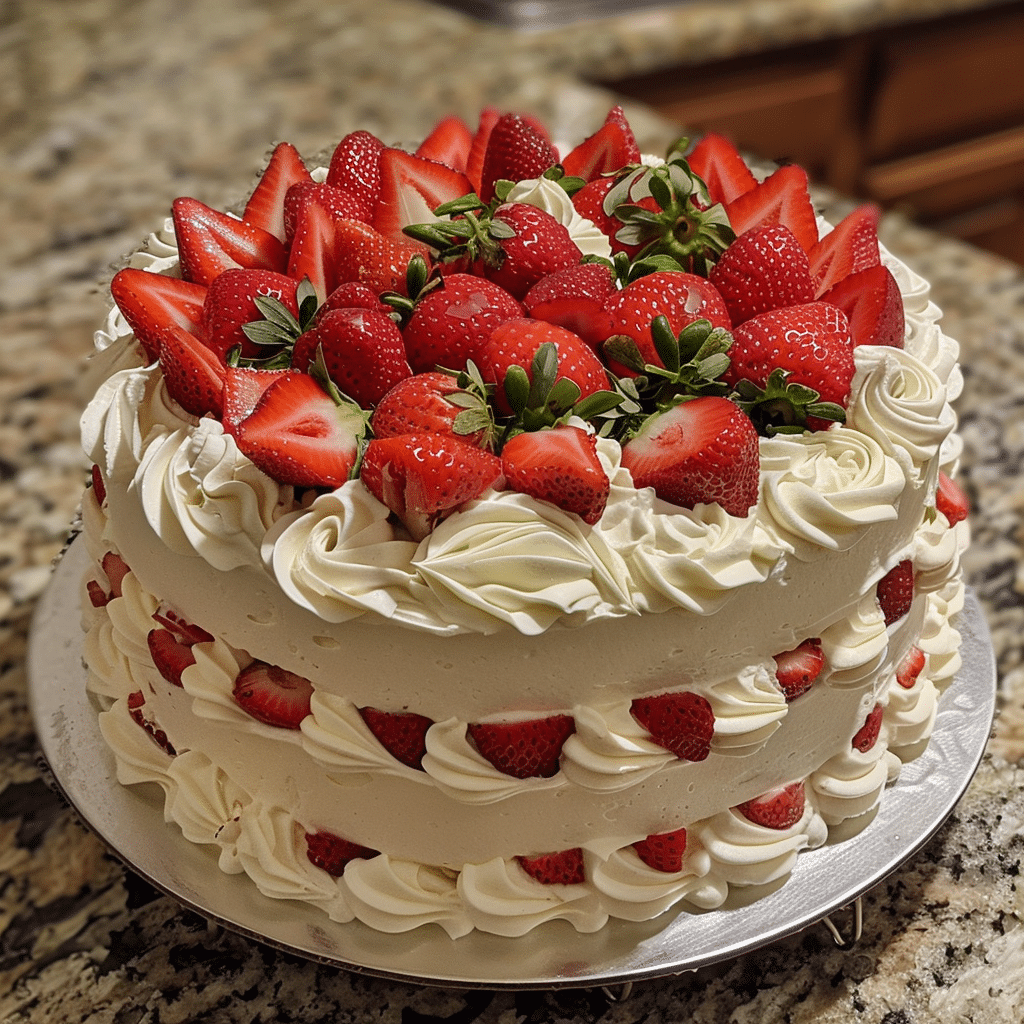
The first cut of this cake reveals a delicate crumble of golden sponge layers, each slice glistening with ruby-red slices of fresh strawberries drenched in a tangy-sweet reduction. Airy clouds of whipped cream cushion every texture, balancing the richness with a whisper of dairy. This is not just dessert but a sensory experience—a harmony of crisp, tender, and tart notes that dissolve cleanly on the tongue.
The scent of ripe berries mingles with warm vanilla as you lift the serving knife. Strata of color and texture unfold: the sponge’s subtle grain, the strawberries’ firm yet juicy structure, and the whipped cream’s billowy peaks that melt into silk with a gentle touch. It’s a dessert engineered for joy, where flavor and form coexist with summer serenity.
Served on a lattice-patterned dish, the Whipped Cream Strawberry Cake becomes a statement. Its architecture defies the heft of traditional layered desserts, inviting bite after bite without guilt. The name itself promises indulgence without extravagance—a philosophy baked into every step of preparation.
- Prep Time-45 minutes
- Cook Time-30 minutes
- Total Time-1 hour 40 minutes
- Servings-12 slices
- Difficulty-Intermediate
- Cuisine-American Summer Classic
Why This Recipe Works
The Whipped Cream Strawberry Cake excels where many desserts stumble. Its structure is buoyant but cohesive, achieved through precise baking techniques and protein-based emulsification in the filling. The strawberries become a liquid asset—sweet, tart, and slightly smoky after caramelization—while the cake remains springy and light. No ingredient weighs the composition down. No flavor overpowers the next.
Whipping technique matters here. The cream should cling to the whisk in soft curls, not stiff peaks. This creates a delicate balance with the cake that holds up in humid weather. Traditional buttercreams would weep or collapse, but this method ensures stability without artificial stabilizers. The strawberries are the anchor. Their natural pectin works with the sugar to create a syrup that coats the sponge without dampening it.
The visual layers are engineered for maximum appeal. Each sponge layer is toasted just until caramelized, adding a nutty depth to contrast the berries’ freshness. The whipped cream acts as a neutral canvas—its role is to frame the star flavors. You’ll marvel at how the components work in tandem, like chefs in a synchronized dance.
The Cultural Soul of Whipped Cream Strawberry Cake
Strawberry desserts have graced tables since the 14th century when the fruit crossed from Asia to Europe. By the 17th century, French patisseries began pairing strawberries with crème chantilly, a tradition that evolved into American-style whipped cream adaptations. Early New England bakers substituted egg whites for milk fat when cream was scarce, a detail preserved in the cake’s structural design.
Post-WWII America embraced desserts that symbolized abundance and simplicity. Whipped cream transformed from a rare luxury to a pantry staple, and strawberries became the poster child for seasonal baking. The cake’s birth as a commercial product occurred in Florida, where year-round berry availability demanded creative uses. The resulting layers captured the fruit’s fleeting springtime glory in a format that could be transported across state lines.
Today’s version pays homage to that heritage with modern science. We now understand how egg proteins create stable mousse-like textures (a nod to European techniques) while maintaining the accessible appeal of classic American layer cakes. The result is something truly cross-cultural—a dish that feels both familiar and revolutionary.
The Elements of the Dish
- 2 cups All-Purpose Flour: Choose bleached flour for tender layers. Unbleached will work but requires extra xanthan gum if gluten-free.
- 3/4 cup Granulated Sugar: Demerara sugar adds sparkle to the top crust. Avoid powdered sugar, which breaks down whipped cream emulsions.
- 5 large Egg Whites: Look for room-temperature eggs with no traces of yolk—they incorporate air more efficiently.
- 1 1/2 cups Heavy Whipping Cream: 36%+ fat content for optimal body. Ultra-pasteurized brands won’t whip properly.
- 2 pints Strawberries: Hull and quarter berries for even cooking. Choose white-sauced varieties like Albion, not firm grocery store hybrids.
- 1/4 cup Lemon Zest: Grate directly into the cream and cake batter for bright notes that cut richness.
- 1/2 cup Butter: Use lightly salted European-style butter for caramel notes and moisture in the reduction.
- 1 vanilla bean Pod: Scraped seeds replace 1 tsp vanilla extract. The pod itself doubles in the strawberry reduction.
The Editor’s Guide to Sourcing
Begin at the farmers’ market. The best strawberries have a cap intact for maximum fragrance, firm bodies with slight give at the base, and no bruising. If fresh strawberries are out of season, frozen ones require double preparation—quick-thaw in a colander (to recover 90% of the juice) then re-caramelize the mushy fruit to mimic fresh pectin behavior.
For the cake, organic eggs and free-range hens produce thicker whites, critical for successful air incorporation. The flour should have a medium protein count (10-12%) to avoid chewiness. Organic sugar retains more mineral notes that enhance the cream’s flavor profile.
Whipping cream quality determines success. Non-homogenized versions from local dairies offer better aeration, though they require cold temps to prevent bacterial spread. The lemon should be zest from organic trees to avoid wax residue. Finally, the butter—its higher moisture content (20% vs typical 16%) creates silkier reductions while contributing essential richness to the cream base.
The Step-by-Step Masterclass
Phase 1: Preparing the Sponge Layers
- Preheat oven to 325° for 7-minute head start. Butter and flour three 8-inch pans with 1/4 inch depth to prevent sticking. Chill pans 10 minutes before batter assembly.
- In bowl, sift flour with 3/4 tsp baking powder. Set aside. In separate bowl, whites will form glossy peaks within 3-4 minutes. Once stiff, stream in 1/3 cup sugar. The mixture should double volume while maintaining sharp peaks.
- Gradually fold in 1/2 cup melted coconut oil (solid at room temp) to maintain air bubbles. Pour 1/3 of batter into first pan. Bake 8 minutes—look for golden edges with slight resistance in center when pressed. Rotate pans every 6 minutes for even doneness.
Phase 2: Strawberry Reduction
- Dice strawberries to 1/2-inch pieces. In sauté pan, caramelize with 2 tbsp brown sugar, 1/2 tsp vanilla extract, and 1/4 cup water. Swirl pan gently—strawberries should release their own juice by 8 minutes cooking.
- Cut butter into cubes and add once syrup turns apricot. Whisk continuously until emulsion thickens and registers 170° on thermometer. Let rest for 15 minutes before straining to remove excess moisture.
Phase 3: Assembling the Cake
- Chill all layers 15 minutes before assembling. This firms them against compression from the filling.
- For the cream, whip 1 1/4 cups cream until foamy. Gently stream in 2 tbsp sugar. Continue until soft peaks collapse into folds when the dropper is removed. Add scraped vanilla and lemon zest—fold 20 times only, stopping when all seeds sink below the surface.
- Place first layer cut-side up. Spoon half the reduction in a spiral pattern. Add 1/3 of cream and gently compress it to form a unified layer. Repeat for middle layer then crown with final cake and remaining filling.
The Kitchen Science
Perfect whipped cream relies on protein-denaturing at 120-130°. Room-temperature egg whites aerate more predictably because their proteins unfold faster when exposed to acid (lemon) and sugar. The cake’s light texture emerges through steam expansion from coconut oil and precise sugar ratios that inhibit gluten formation.
Berry reduction achieves emulsification through pectin activation—heated in a 3-1-1 sugar-cream-fruit ratio. Salt in the butter interacts with sugar, enhancing the strawberries’ sweetness while preventing weeping. When layering, the moisture balance is critical: too much syrup and the sponge becomes sodden; too little and the filling fails to integrate with the base.
Pro-Level Secrets
- Use an immersion blender to aerate cream directly in its container. Transfer to bowl for stability.
- Freeze the assembled cake for 30 minutes before cutting—prevents cream slumping and preserves sharp layers.
- Replace 10% of sugar in cream with agar agar for vegan structure without altering flavor profiles.
- Brush cake layers with a 10% cornstarch slurry before adding reduction—creates a starch-fruit membrane for perfect moisture control.
- Age vanilla pod in the reduction overnight for 12 hours—deepens berry notes without sweetness masking.
- Test strawberries for doneness by piercing with skewer—the juice should cling briefly to the utensil, not run freely.
Common Mistakes to Avoid
- Over-whipping cream—Why: Breaks emulsion into butter and syrup. Solution: Stop at first trace of stiff peaks, check temperature after 3 minutes.
- Underseasoning reduction—Why: Fruit notes become flat. Solution: Add 1 pinch of salt per cup strawberries to highlight sweetness.
- Room-temp cake layers—Why: Causes cream sliding. Solution: Store layers in fridge at 40° for 20 minutes pre-assembly.
- Skip sifting flour—Why: Lumps become texture flaws. Solution: Sift into separate bowl twice, then fluff before measuring.
- Using 100% organic vanilla extract—Why: Excessive aldehyde molecules overpower. Solution: Mix with 20% plain extract for balanced flavor.
Creative Adaptations
| Substitution | Impact |
| Coconut Milk for Cream | Reduces saturated fat, creates tropical undertone. Slight curdling possible if not pasteurized correctly. |
| Lemon Juice for Zest | Less aromatic but maintains acidity balance. Use 2 tbsp juice in filling, 1 tbsp in cream. |
| Balsamic Vinegar for Vanilla Pod | Adds sweet-tangy complexity to reduction. Use only 1/8 cup to avoid overpowering the strawberries. |
| Peaches for Strawberries | Softens flavor intensity. Add 2 tbsp peach puree to cream for consistency matching. Pits must be fully removed. |
| Citrus Zest for Lemon | Orange or grapefruit adds boldness. Adjust syrup sugar by 10% to offset citrus intensity. |
Plating & Pairing
Plate the cake on slate or dark wood to make colors pop. Arrange extra strawberries around the perimeter with edible flowers like nasturtiums for visual cohesion. Keep ambient temperatures between 68-73°—higher temps cause cream to sag between layers.
Pair with iced hibiscus tea to contrast the richness. For brunch, a tangy Greek yogurt alongside adds texture variation. Avoid heavy desserts like chocolate lava cake in adjacent service—the shared sweetness profile will create flavor fatigue.
Preservation Guide
| Storage | Duration | Nutrition Notes |
| Refrigerated, airtight | 4 days | Sugar stabilizes emulsions but may attract yeast over time. Check for softness in cream layer. |
| Frozen, parchment-wrapped | 3 months | Sponge resists freezer burn but cream layers may weep upon thawing. Freeze unfrosted then add cream after thawing. |
| Reheating | Not recommended | Dehydration causes cream to collapse. Best served at fridge temp (38-40°) for optimal texture. |
Questions from Our Kitchen
Can I use fresh vs frozen strawberries in the same recipe?
Fresh berries require 3 minutes less coking time due to natural sugar content. Frozen need double the water to prevent jamming but create a slightly denser fruit consistency. Always thaw frozen first and pat dry before reducing.
How do I test if my cream is whipped properly?
Cold cream poured in should form slow-forming soft peaks that gently fold into themselves. If the liquid runs off a spoon immediately, continue beating. If it forms a hard ball when scraped, it’s over-whipped and needs fresh cream added.
What creates the ‘light-as-cloud’ texture?
Three factors: room-temp egg whites whipped to stiff glossy peaks, gradual sugar addition during emulsification, and minimal folding during cream incorporation. Any deviation risks collapsing aeration or introducing water that destabilizes air bubbles.
Can this cake stay out at room temperature?
Unfrosted layers can rest 12 hours maximum. Frosted cake requires 17-20 hours refrigeration to prevent dairy separation. In humid climates, refrigeration is essential within 30 minutes of assembly.
Why does my cream weep on top of cake?
Three possibilities: Over-whipping the base, using low-fat cream, or adding sugar too early. Always whip at 40°, check fat content on label, and add sugar while maintaining continuous motion for at least 90 seconds of integration.
Conclusion: The Whipped Cream Strawberry Cake is not just dessert—it is an argument for slow cooking and careful preparation. When you follow these techniques with patience, you create something that defies conventional categorization. It is as much a summer ritual as a firepit gathering or a twilight stroll. The cake will bring people to your table, but your care will make them stay. Preheat your oven, grab your finest berries, and let’s transform sugar and air into a masterpiece tonight.
Print
Whipped Cream Strawberry Cake
- Total Time: 100
- Yield: 12 slices 1x
- Diet: Vegetarian
Description
A light, fluffy sponge cake layered with fresh strawberries and airy whipped cream. Tangy-sweet reductions and golden crumbs create a harmonious summer dessert with no heaviness.
Ingredients
2 ½ cups all-purpose flour
1 ½ cups granulated sugar
4 large eggs
1 cup unsalted butter, softened
1 cup milk
2 teaspoons vanilla extract
1 teaspoon baking soda
Pinch of salt
6 cups fresh strawberries, sliced
1 cup sugar (for reduction)
2 cups heavy whipping cream
3 tablespoons powdered sugar
1 tablespoon fresh lemon juice
Instructions
Preheat oven to 350°F (180°C). Grease and flour three 8-inch round cake pans.
In a bowl, whisk flour, baking soda, and salt.
In a separate bowl, beat eggs with granulated sugar until pale and thick.
Mix in softened butter, milk, and vanilla until smooth. Gradually fold in dry ingredients.
Divide batter into pans and bake 25-30 minutes until golden. Cool completely.
In a saucepan, simmer strawberries and sugar over medium heat until softened (5-7 minutes). Strain syrup; set aside.
Whip cream, powdered sugar, and lemon juice until soft peaks form.
Layer cooled sponges with whipped cream and strawberry slices. Brush strawberry syrup between layers.
Frost top and sides with whipped cream and garnish with remaining strawberries.
Notes
For stability in warm weather, refrigerate cake before serving. Toasted cake layers enhance caramelized flavor.
Use fully ripe strawberries for maximum sweetness and juice.
Store in the refrigerator, covered, for up to 48 hours.
- Prep Time: 45
- Cook Time: 30
- Category: Dessert
- Method: Baking
- Cuisine: American
Nutrition
- Serving Size: 1 slice
- Calories: 420
- Sugar: 50g
- Sodium: 700mg
- Fat: 22g
- Saturated Fat: 14g
- Carbohydrates: 50g
- Fiber: 2g
- Protein: 5g
- Cholesterol: 80mg