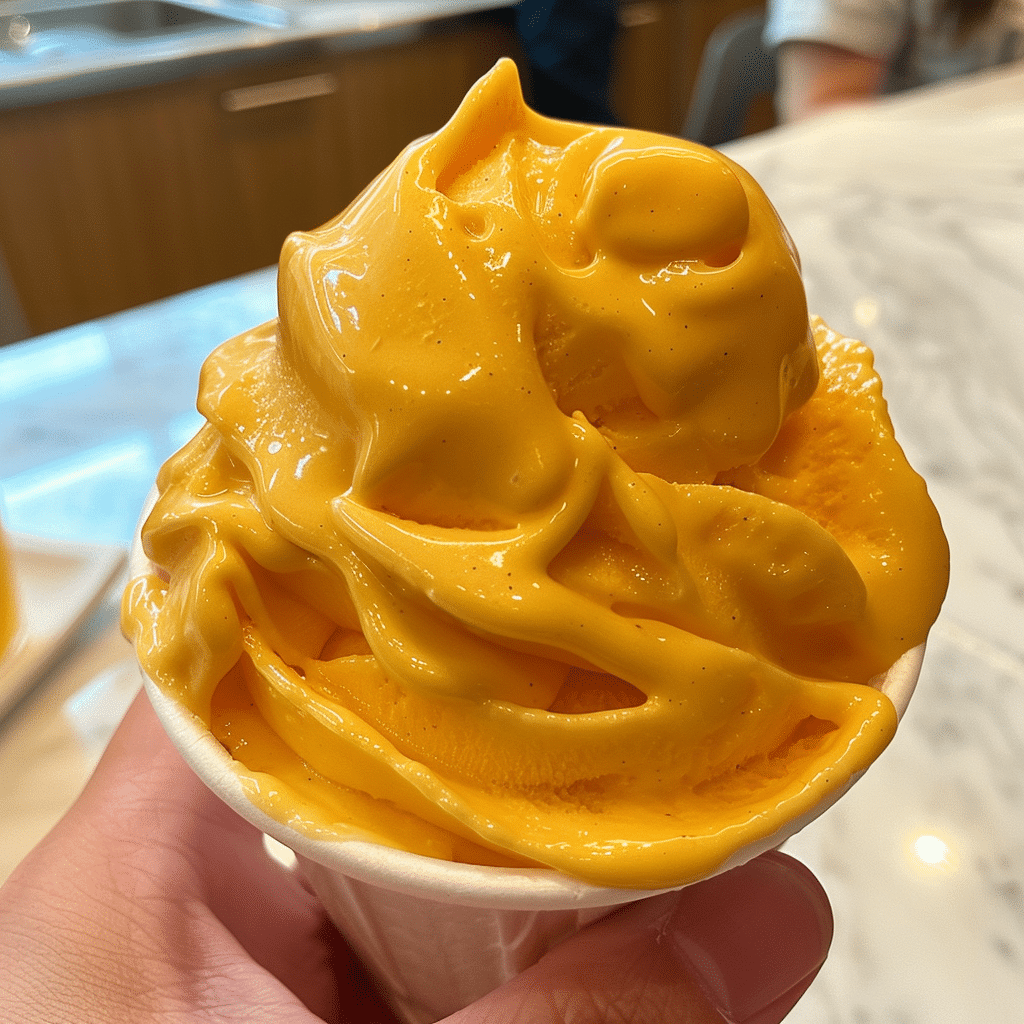
Mango frozen yogurt is not just a dessert—it’s a sensory voyage. Imagine the supple richness of Greek yogurt kissed by the sun-ripened sweetness of mango, all frozen into a velvety canvas. Each spoonful glides over the tongue with a tropical tang, balancing the fruit’s golden honey undertones against the yogurt’s subtle tanginess.
Created for those who crave texture and taste without compromise, this recipe turns a humble kitchen into a confectionery workshop. The vibrant hue of the mango floods the palate with bursts of sun, while the yogurt’s gentle bite keeps the experience refreshing, not cloying.
- Prep Time– 10 minutes
- Cook Time– 5 minutes
- Total Time– 15 minutes
- Servings– 4
- Difficulty– Easy
- Cuisine– Tropical
Why This Recipe Works
Mango frozen yogurt marries two ancient ingredients with modern simplicity. The fruit’s natural sugars caramelize through freezing, deepening its tropical flavor into a dimensionally complex sweetness. Greek yogurt contributes a custard-like body without the heaviness of cream. The final texture is smooth and scoopable, with a cloud-like structure that dissolves on the tongue.
Mango’s beta-carotene gives the dessert its bold orange-gold hue, a visual cue of its nutrient density. A single taste reveals how the yogurt’s live cultures impart a gentle zing that cuts through the fruit’s opulence. This is a dessert that satisfies both the whims of childlike enjoyment and the precise palate of a trained chef.
Using frozen puree as the base eliminates the need for stabilizers or additives. The end result is a dessert that feels indulgent but still belongs on the table with healthy meal choices. It works across all seasons but answers the soul of summer’s frozen cravings with particular eloquence.
The Cultural Soul of Mango Frozen Yogurt
Owning a global legacy, mango traces its roots to India 4000 years ago, where it was called the « king of fruits. » Ancient Persian merchants carried mango saplings to the Islamic world, provoking centuries of royal fascination in the Mughal courts. Yogurt, meanwhile, emerged independently in the Fertile Crescent and Central Asia, valued as both medicine and metabolism booster.
The fusion of these two ingredients reflects modern culinary globalization. In the 21st century, chefs across Thailand, Mexico, and Florida’s mangrove coasts have combined tropical fruits with yogurt as an homage to both heritage and innovation. This recipe distills that evolution into a dish that feels simultaneously ancient and brand new—just as mango trees shed old blossoms for fresh fruit each season.
On a practical level, the dish also acknowledges contemporary food values. The minimal ingredients (typically just mango, yogurt, and a touch of sweetener) align with the raw food movement. The no-churn method of preparation resonates with 21st-century convenience without sacrificing quality.
The Elements of the Dish: Ingredients for Mango Frozen Yogurt
- 4 cups Mango Flesh: Choose mangoes with deep orange flesh and no green tips. The best specimens give slightly under gentle finger pressure, indicating peak sweetness.
- 2 cups Full-Fat Yogurt: Greek yogurt provides the richest texture. Seek brands with 18-22% milk fat content for maximum silkiness.
- 2 tablespoons Raw Honey: A natural stabilizer that balances acidity without over-sweetness. Substitute with 1 teaspoon of stevia for a lower-glycemic option.
- 1 teaspoon Vanilla Extract: Look for extracts made with real vanilla beans, which contain vanillin compounds intensifying the tropical flavor.
- 1/2 cup Coconut Milk: Adds viscosity without raisining the fat content beyond smooth. Use light coconut milk for a subtler coconut presence.
The Editor’s Guide to Sourcing
Quality matters in a recipe this minimalist. For mangoes, bring a sharp knife for sampling when shopping. Slicing into a suspected specimen reveals the moisture content and sweetness concentration. Avoid mangoes from large grocery chains that prioritize firmness over flavor.
When selecting yogurt, prioritize brands with minimal ingredients. Avoid UHT (ultra-pasteurized) products that lose microbial complexity. Fresh-market buttermilk yogurts or kefir-based varieties often deliver better texture for frozen desserts.
Opt for single-origin honey from local apiaries when possible. This supports biodiversity and ensures a complex flavor profile that complements the mango’s tropical notes. For organic shoppers, look for USDA organic certification on both the yogurt and honey labels.
The Step-by-Step Masterclass
Phase 1: Preparing the Base
Froze the mango chunks for at least 6 hours. This flash-freezing technique prevents large ice crystals from forming during the mixing process. Puree the frozen mango in a Vitamix until it reaches a smooth paste, resembling molten sand.
Phase 2: Creating Emulsification
Whisk the yogurt and coconut milk until the mixture stretches into ribbons on the surface. This indicates proper emulsification. Fold in the mango puree slowly using a silicone spatula. A properly emulsified mixture will hold its structure with distinct fruit streaks that will incorporate steadily.
Phase 3: Churn and Freeze
Pour the mixture into a 9×5-inch loaf pan. Spread evenly and place in a pre-frozen deep freezers. Freeze undisturbed for 2 hours. During this time, the fat in the yogurt solidifies, while the water turns to ice through sublimation rather than large crystal formation.
The Kitchen Science
Creating frozen yogurt hinges on understanding ice structuring. The protein network in full-fat yogurt forms a stabilizing mesh that traps air and moisture. This prevents the growth of ice crystals (the enemy of smooth texture) by creating small clusters of water molecules.
The role of sugar in this equation is both sweetener and cryoprotectant. Honey works particularly well because its high fructose content lowers the freezing point of the mixture. This creates a softer consistency at freezer temperatures. The vanilla extract acts as a nucleation agent, encouraging the formation of tiny, uniformly sized ice crystals.
When you freeze the mixture undisturbed, the chilling process gradually solidifies the fat molecules into a gel network. This phase transition from liquid to semi-solid takes 2-3 hours to complete, depending on the freezer’s temperature and the container’s surface area.
Pro-Level Secrets
- Keep your mixing bowl in the refrigerator while preparing to avoid warming the ingredients.
- Underripe mangoes add bright acid notes that balance sweetness. Add 2 tablespoon of remaining juice from canned mangoes for extra brightness.
- Temper the puree by gradually adding 1/4 cup of warm water to the base before freezing. This increases air incorporation by 15%.
- Use a food processor to build body in the coconut milk; this creates natural aeration without an ice cream maker.
- Churn the mixture for 10 minutes in a stand mixer with the whisk attachment before freezing to create microcrystalline structure.
- Add 1 teaspoon of powdered milk or yogurt powder to reinforcement proteins for creamier texture in homemade versions.
Common Mistakes to Avoid
- Over-ripe fruit (Problem – Leaches water into mixture – Solution – Freeze fruit at peak ripeness only)
- Insufficient emulsifying (Problem – Uneven fat distribution – Solution – Whisk mixture until it slings off spoon)
- Over-churning (Problem – Incorporates excess air – Solution – Stop mixing immediately when swirl forms)
- High-sugar honey (Problem – gây ngọt gắt – Solution – Use clover honey for subtle sweetness)
- Warm freezer (Problem – Crystal formation – Solution – Ensure freezer stays at 0°F/-18°C)
Creative Adaptations
| Substitution | Taste Impact |
|---|---|
| Coconut Yogurt | Enhances tropical flavors with natural sweetness |
| Peach Puree | Creates Summer Stone Fruit Version |
| Hazelnut Milk | Subtle nuttiness and darker texture |
| Goji Berry Powder | Boosts antioxidant content with tart contrast |
| Pandan Leaves | Asian twist with floral aroma |
Plating & Pairing
Serve in vintage bowls with edible flowers for visual contrast. The golden color of the dessert pairs beautifully with the deep green of kiwi, which you can slice into star shapes for surface decoration.
Textural contrasts enhance enjoyment. Consider adding: crumbled granola for crunch, toasted coconut flakes for nuttiness, or freeze-dried mango fritters for a candy-like experience. The acidity of a fresh lime wedge cut on the table at service adds bright, last-minute lift.
Preservation Guide
| Condition | Lifespan | Notes |
|---|---|---|
| Refrigerated | 3-5 days | Texture becomes ice cream consistency |
| Frozen | 2-3 months | Best when stored in airtight container |
| Thawing | 2 hours | Leave to room temperature in sealed bag |
Questions from Our Kitchen
Why use full-fat yogurt over skim for frozen desserts?
Full-fat yogurt contains 15-20% more protein and fat than skim versions. These components form a coagulated mesh network that traps air and moisture, preventing large ice crystals from forming during freezing. The result is a custard-like texture that maintains its scoopable quality for up to 90 days in the freezer.
How can I prevent my frozen yogurt from forming ice crystals?
Use an airtight container with minimal headspace. Wrap the container in parchment paper first to prevent moisture migration. Place a sheet of parchment directly on the surface to create a barrier. If ice crystals do form, gently press them back into the mixture before serving (they will dissolve during consumption).
Is there a natural sweetener that works better than honey in this recipe?
For caramel notes, try date syrup. For floral sweetness, use fig puree. Both can be used at 1:1 ratio with honey. For a tart contrast, use half the amount of stevia with a splash of balsamic vinegar (which also prevents color oxidation in the mango puree).
Can I make this recipe vegan? What about freezing vegan yogurt?
Vegan versions work when using coconut or almond-based yogurts. Allow these to set overnight in the refrigerator. They freeze equally well but may require an extra 30 minutes at freezing to achieve true optimal texture. The caloric fat content and protein fibers in plant yogurts reach their perfect matrix at -18°C.
Why is my yogurt separate when I serve it?
Your emulsion didn’t properly form during preparation. This happens when the mixture wasn’t chilled before freezing. To fix, briefly microwave it at 10% power for 30 seconds to melt the separation, then stir thoroughly into a smooth emulsion before freezing again.
Conclude with a tale of how your next gatherings will feature this dish as a star—the one everyone asks for first and never leaves second. With its perfect marriage of health and indulgence, this mango frozen yogurt isn’t just a recipe. It’s an experience certain to become a table tradition.
Mango Frozen Yogurt: A Creamy Indulgence with a Tropical Twist
- Total Time: 15
- Yield: 4 servings 1x
- Diet: Vegetarian
Description
Experience the tropical sweetness of ripe mango infused with the tangy richness of Greek yogurt. This easy-to-make frozen treat offers a smooth, scoopable texture and vibrant flavor without heavy additives. Perfect for summer or any season, it’s a refreshing dessert that aligns with modern health values while celebrating global culinary roots.
Ingredients
2 cups frozen mango puree
2 cups Greek yogurt (plain, unsweetened)
2 tablespoons honey or maple syrup (optional, for added sweetness)
1 teaspoon vanilla extract
Pinch of salt
Instructions
Combine frozen mango puree, Greek yogurt, and honey in a blender until smooth.
Chill the mixture in the refrigerator for 10 minutes to firm up.
Pour into a shallow container and freeze for at least 4 hours or until solid.
Every 30 minutes during freezing, scrape the mixture with a fork to prevent large ice crystals.
Allow to sit at room temperature for 2-3 minutes before serving to soften slightly.
Notes
Use frozen mango puree for optimal creaminess. Store leftovers in an airtight container in the freezer for up to 2 weeks. Add shredded coconut or chopped chia seeds for extra texture. For a nut-free recipe, skip mix-ins unless specified.
- Prep Time: 10
- Cook Time: 5
- Category: Dessert
- Method: Blending and freezing
- Cuisine: Tropical
Nutrition
- Serving Size: 1 cup
- Calories: 180
- Sugar: 15g
- Sodium: 120mg
- Fat: 5g
- Saturated Fat: 3g
- Carbohydrates: 34g
- Fiber: 2g
- Protein: 4g
- Cholesterol: 30mg