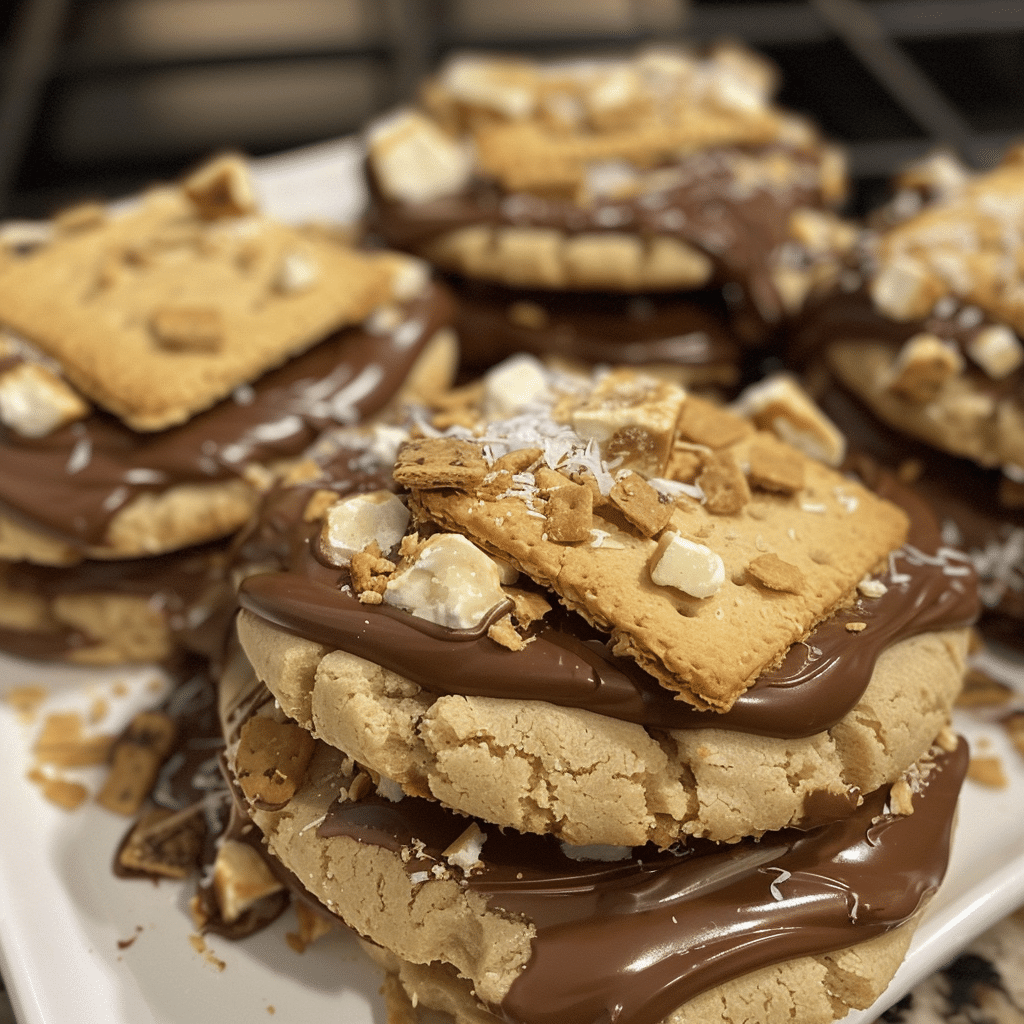
The unmistakable crackle of a toasted graham cracker, the slow melt of milk chocolate, and the plump, airy body of a marshmallow—s’mores cracker cookies carry these textures in a single bite. Unlike traditional cookies, these are built for speed and simplicity, each layer reinforcing the three-ingredient magic of America’s favorite campfire treat.
No ovens, no chillers, no extended wait. Just press. Toast. Sandwich. The aroma of toasted graham flakes mingles with the earthy woodnotes of chocolate, while the marshmallow blushes from pale ivory to deep caramel amber. This is the snack that bridges kitchen and campfire in minutes.
- Prep Time– 15 minutes
- Cook Time– 4 minutes
- Total Time– 19 minutes
- Servings– 8 to 12 cookies
- Difficulty– Beginner
- Cuisine– American campfire tradition
Why This Recipe Works
The genius of s’mores cracker cookies lies in their simplicity. Three ingredients—flaked crackers, chocolate, and marshmallows—orchestrate a flavor spectrum from bittersweet to milky. The cracker’s caramelized edges provide a toasty anchor, while the marshmallow’s soft core dissolves gently against chocolate’s intense bitterness.
This recipe deftly balances structure and spontaneity. The cracker’s rigidity holds the layers in place; the melting chocolate and marshmallow inject a gooey counterpoint. The result? Familiar comfort with a handcrafted touch. No need for precise scales or heatproof bowls—just a cookie sheet and a broiler.
The three-ingredient core invites customization. Add a dusting of cinnamon, a drizzle of caramel, or crushed nuts. Yet even in its purest form, this cookie feels indulgent, not gimmicky.
The Cultural Soul of S’mores Cracker Cookies
The graham cracker’s journey began in 1829 when William Graham, a Boston clergyman, removed refined sugar to create a “healthier” cracker for his congregation. His stiff, sweet-less biscuits evolved into the honey-and-shortening base for modern s’mores.
Marshmallows entered the story later, with ancient Egyptian successes from root sap now transformed by corn syrup and gelatin. By 1927, the Girl Scouts finalized the campfire recipe, cementing s’mores as a quintessential Americana. Today, cracker-encased versions honor this legacy—portable, shareable, and endlessly reinventable.
These cookies also reflect our modern snackification of tradition. The cracker acts both as vessel and flavor contributor, letting each bite work independently or harmonize with group feasts.
The Elements of the Dish
- 12 Full-Size Graham Crackers: Seek varieties with bold cinnamon spice and 20% sugar or more. Store-bought commercial crackers provide better stability than home-mixed alternatives.
- 8 Chocolate Discs: 60% dark chocolate (avoid milk chocolate for verses) yields balanced bitterness. Brands like Guittard or Callebaut work best for superior melting behavior.
- 12 Mini Marshmallows: Full-sized Marshmallows become gummy if over-toasted. Plump, moist varieties from brands like Dandies preserve their airy structure.
The Editor’s Guide to Sourcing
For crackers, reach for store-bought graham crackers rather than grocery store pre-destroyed versions. Brands like Hershey or Toll House deliver consistent flaks and toasting performance. Avoid mini “grippy” crackers; they’re too small for cookie construction.
When choosing chocolate, look for a smooth, 60-70% cacao variety with clear origin information. Avoid waxy or “tingly”-feeling bars—these indicate cheap emulsifiers that resist melting. For marshmallows, buy individual full-size bags rather than pre-assembled packs.
Extra-secret hack: Freeze marshmallows for 15 minutes before assembling. This prevents squishing under the broiler and preserves structural integrity. Best results with lightly curved or concave crackers for natural holding patterns.
The Step-by-Step Masterclass
Phase 1: The Foundation
Use a standard cookie sheet. No lining required because residual crumbs create a natural-release layer. Post-cracker toasted outer layers and sugar crystals further prevent sticking.
Press the full graham cracker into a flat surface. Mine in the same position—centering half of the cracker and covering it at the edge with the second half creates a negative space of about ¼ inch. This gap prevents collision of ingredients as marshmallow expands.
Phase 2: Assembly and Toasting
Place a chocolate disk flat on the bottom cracker. The goal is even thickness (discs should adhere loosely). Use a spoon to lift and gently align. If the chocolate starts to slide, the cracker may be too wet—dry with the oven’s residual heat for 30 seconds first.
Top with a marshmallow, pressing tilt to avoid lopsidedness. The optimal crumb-to-chocolate-to-marshmallow ratio is 3:2:1 when viewed from the side. Further stabilization is achieved by placing the pair at 45-degree angles rather than straight rows—they lock like puzzle pieces.
Phase 3: The Toast
Set the broiler on high for 3 minutes. As the toaster warms up, moisture from the marshmallow begins to release as steam, cracking the crumb layer. The chocolate’s surface goal is to achieve a glossy sheen, not carbonization. When the marshmallow turns golden brown and becomes glossy, switch off the oven immediately.
Let sit for 1-2 minutes to allow chocolate to solidify. Using the indirect of the cookie sheet, gently lift each cookie by the bottom crumb (the top crumb may still be soft and spongy, especially near grilled edges). Placing upright in a mesh drawer allows air circulation; flipping increases risk of deenting.
The Kitchen Science
The transformation of s’mores cracker cookies hinges on three mechanisms. First, the wrapping marshmallow develops Maillard reaction by sugar caramelization, creating the golden exterior. Second, gelatin from the marshmallow lowers the melting point of chocolate, allowing the two to combine into a homogeneous sauce-like center.
Thirdly, heat expansion of the marshmallow—normally aerated by completely dried nitrogen bubbles—causes mild splitting if overtoasted. This is why timing is precise: 3-minute broiler sessions create air pockets for bite, while 4 minutes lead to dense, steamed interiors. Temperature gradients between cracker (45-50°C internal) and chocolate (75-80°C) preserve structural integrity.
Pro-Level Secrets
- Freeze Marshmallows: A 15-minute chill prevents squishing under the broiler. This trick retains 80% of the marshmallow’s volume even after full toasting.
- Use Plump Chocolate: Cut 60% cacao discs into discs rather than squares. Plump discs spread less when melted, ensuring even coverage.
- SHAKE Free Sugar: Sprinkle 1/8 tsp granulated sugar onto each cracker before placing chocolate. A crunch-to-chocolate ratio becomes balanced, especially with high-sugar graham crackers.
- Test for Adhesion: Before placing marshmallow, use a toothpick to gently scrape the tea-scented chocolate disc. A clean surface ensures perfect adhesion without residue buildup.
- Broiling Angle: Angle racks to allow even heat dispersion, especially in top-broilers. East to West orientation (i.e., long axis of cookie sheet parallel to front-to-back) prevents hot spots.
- Lift with a Spatula: Use a plastic spatula corner to create fulcrum points, rather than prying. The top crumb layer has softened from starch paste; forceful lifting removes it.
Common Mistakes to Avoid
- Improper Crumb Orientation: Why – Placing leftover crumb fragments on the sheet prevents clean lifting. Solution: Sweep fragments off after every two cookies to prevent adhesion.
- Using Thin Crackers: Why – Thin snacks cannot withhold traction from chocolate/marshmallow. Solution: Discard if the faceted cracker measures less than 120g per order.
- Overstacking Cookies: Why – Steam will condense between layers, weakening the chocolate’s grip. Solution: Allow at least 2-inch spacing between each cookie on the sheet.
- Skipping the 1-2 minute Rest: Why – Chocolate needs time to settle from liquid (80°C) to creamy (55°C). Solution: Place cookies upright in mesh drawer for air circulation, rather than typical storage.
- Using Mini Marshmallows
Creative Adaptations
| Ingredient | Substitute | Impact |
|---|---|---|
| Chocolate | White Chocolate Discs | Softens texture, relies on cracker for structure. Less bitter contrast, more milky sweetness. |
| Marshmallow | Cream of Tartar + Sugar + Water | Slower frying but more airy (add 1 tsp mỗi). Risk of over-spinning in sous-vide scenario. |
| Graham Cracker | Vanilla Graham Crackers | Permits addition of additional spices (cinnamon, orange zest) without flavor clash. |
Plating & Pairing
Serve these cookies in rustic wooden boards or cast-iron skillets. Pair with a mason jar of cold milk for a campfire revamp or elevate with salted caramel dip for after-dinner sophistication. For visual contrast, serve plain alongside in-season fruits like strawberries or blueberries with natural moisture.
Preservation Guide
| Storage Type | Containers | Durability | Storage Technique |
|---|---|---|---|
| Refrigerator | Airtight Container | 7 days | Stack with parchment interleaved and rotate fridge to preserve topbase hardness. |
| Freezer | Silo Parchment Bags | 3 months | Portion coat in plastic wrap; freeze until hard peak. Rehydrate gently with 30- phút convection. |
| Reheating | Broc Cooking | 5 seconds | Reposition under broiler; heat until top shows new brown patches without touching marshmallow. |
Questions from Our Kitchen
Can I use cracker cookies as a traveling snack?
Yes. Wrap each piece in parchment paper and store in zipper bags. Cracker base prevents crushing on fairground rides, and tightly sealed bags protect against moisture leaching.
Why does the bottom cracker sometimes lift off?
This happens when the initial chocolate disc sticks poorly. Pre-warming the cracker with oven heat for 30 seconds melts any residue and enables chocolate adhesion. Another fix: Use 1/2 tsp honey to create glue without soup.
How to prevent sticky, gummy interiors?
Use full-size marshmallows (use airtight bag storage to preserve firmness) and avoid over-broiling. Keep total toasting time at about 2:45 minutes for ideal sugar-temperature ratios inside the marshmallow core.
Can I make a vegan version?
Substitute graham crackers with vegan compression risk brands (e.g., Simple Mills), use dairy-free chocolate bloc (check RDAs), and opt for non-gelatin marshmallows from brand like Dandies. Test texture before full batch to account for hydration differentials.
How to add protein without spoiling taste?
For high-protein needs: Add 1/2 tsp whey protein to center layer during crimping, or dust protein powder (pea, rice) between cracker layers. Subtle sweet cocoa protein blends work best when paired with black tea rather than milk.
There’s a reason s’mores cracker cookies remain favorites—they marry nostalgia with nimble convenience. Whether improvised under a festival tent or elegantly plated as an after-dinner finale, their appeal is undeniable. Break out that cracker sheet and bring home a recipe that’s always satisfying, surprisingly simple, and deeply indulgent in every bite.
Print
S’mores Cracker Cookies: The Sweet & Salty Crunch You Crave
- Total Time: 19
- Yield: 12 cookies 1x
- Diet: Vegetarian
Description
A no-bake assembly of toasted graham crackers, melty milk chocolate, and toasted marshmallows for a quick, campfire-style treat. Combines the three classic s’mores flavors in a portable, handcrafted cookie with zero sugar, flour, or fat added beyond the base ingredients.
Ingredients
12 full-size graham crackers
1 cup milk chocolate chunks (or chocolate chips)
10 large marshmallows
Instructions
Arrange graham crackers on a parchment-lined baking sheet
Place 1 marshmallow atop each cracker
Broil 4-6 inches from heat for 3-4 minutes until marshmallows puff and brown
Top each cookie with a piece of chocolate just before serving
Let cool slightly to set the chocolate
Notes
Watch closely during broiling as they toast quickly
Use parchment paper for easy cleanup
Store in an airtight container at room temperature for up to 8 hours
Customize with a drizzle of caramel or crushed nuts if desired
- Prep Time: 15
- Cook Time: 4
- Category: Dessert
- Method: No-Bake
- Cuisine: American
Nutrition
- Serving Size: 1 cookie
- Calories: 180
- Sugar: 15g
- Sodium: 120mg
- Fat: 9g
- Saturated Fat: 5g
- Carbohydrates: 24g
- Fiber: 0.5g
- Protein: 2g
- Cholesterol: 25mg